1. Pioneering 3d Transition Metals Coordination Polymers as Novel Electrocatalysts for Metal-air Batteries JSPS Kakenhi C Grant (2020-2023)
In this project, we are working on developing new electrocatalysts for oxygen evolution reaction (OER) and oxygen reduction reaction (ORR) working in alkaline solutions. Lithium-air batteries have attracted focus of many research groups worldwide due to their higher theoretical gravimetric energy density in comparison to the current Li-ion batteries. With the three times higher energy density, such batteries could power electrical vehicles up to 500 km distance on a single charge. Commercialization of these batteries is hindered by the development of bifunctional catalyst that can efficiently catalyze both ORR and OER. Under this project, we proposed a new method for preparing an efficient electrocatalyst for alkaline media. The method includes in situ electrochemical transformation of Cu and Ni chelate polymers into copper oxides nickel oxyhydroxides well-dispersed in the carbon matrix.
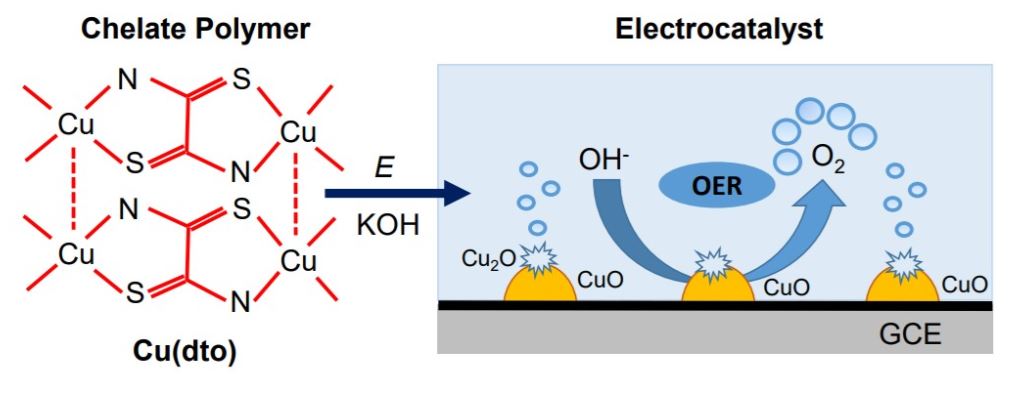
Transformation of Cu(dto) chelate polymer in 1M KOH results in formation of nanostructured CuO and Cu2O oxides. Post cycling XRD showed that CuO is cative towards OER and Cu2O catalyzes ORR.
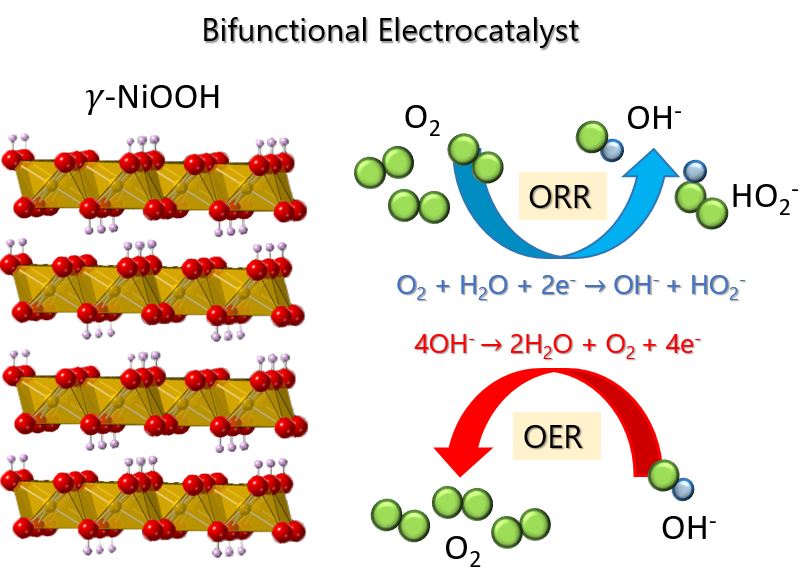
Transformation of Ni(dto) in 1 M KOH leads to formation of nanostructured NiOOH. Particularly, gamma phase was found active towards OER and ORR.
2. Sustainable well-being through rapid detection, remediation and stakeholder awareness of
contaminants in environments impacted by mining activities
(Japan Science and Technology Agency Strategic International Collaborative Research Program (SICORP), Grant Number JPMJSC22A2, Japan)
The aim of the project is to provide pollutants-free water and food to communities impacted by metal mining activities in Botswana. For this, our integrative research activities is focusing on the
development of low-cost ceramic biochar nanoparticle impregnated composite filters for water
purification from heavy metals (HMs) and microorganisms, smartphone-based device for quick detection of HMs in drinking water, and strategy to reduce HMs and microplastics in the soil
and water around mining sites. On this project we collaborate with Botswana University of Science and Technology (Prof. Venecio Ultra); University of Johannesburg (Prof. Mabuba, Nonhlangabezo), Sol Plaatje University, South Africa (Prof. N. Chaukura) and in Japan with Kyoto University (Dr. Sylwia Oleszek) and Kagoshima University (Assoc. Prof. Mun’delanji C.M. VESTERGAARD).
 Surface Chemistry & Catalysis